A tunnel in the DSEC test set. The frame goes dark, then saturates at the exit. The flow stays dense.
Abstract
Event cameras capture fast motion and extreme lighting where frame cameras fail, making event-based optical flow essential for agile robots and autonomous driving. Since events vanish in static and untextured regions, recent methods fuse them with RGB frames. However, current fusion methods are only marginally better than using events alone. In this paper, we introduce UltimateFlow, which rethinks how frames should be used for event-based optical flow. Rather than fusing frame features, we utilize a frozen RGB optical flow network, built on a depth foundation model, to provide an initial flow estimate and a per-pixel reliability map. A recurrent event-based estimator, built on an event depth foundation model, then refines this estimate without requiring additional labels. UltimateFlow achieves state-of-the-art results on the DSEC optical flow benchmark, ranking first of 39 entries with an endpoint error (EPE) of 0.554.
Qualitative Comparison
Drag the slider. The right side is always UltimateFlow (E+I).
Labels give the EPE on the whole test sequence, from the benchmark server. The public baseline checkpoints were trained on the validation sequence. UltimateFlow (E+I) is the 5-model ensemble.
Dense Guidance Versus Output Fusion
A frozen frame-based flow model, the guide, sees the texture that events miss. There are two ways to use it.
Blend at the Output
One weight serves every pixel inside the gate . The estimator never sees the guide.
Guide at the Input
Guide flow, gate and residual are inputs, and the refinement starts from the guide. The estimator decides per pixel.
Method
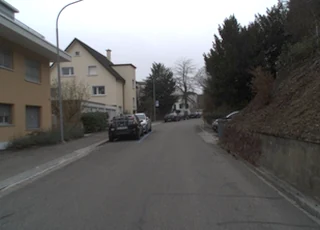 RGB Frames
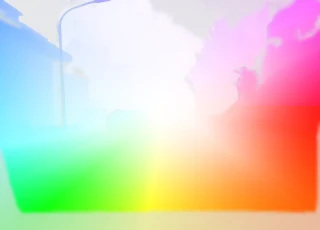 Guide Flowits motion estimate
 Gatepixels it trusts
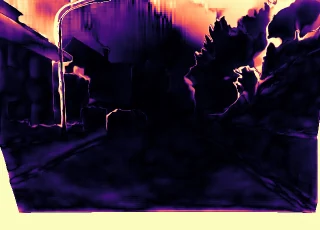 Residualround-trip error
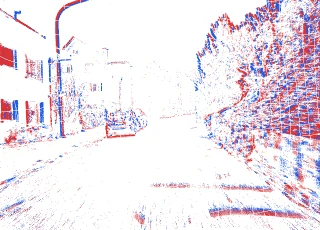 Events
 UltimateFlow (E+I)
DSEC-Flow Benchmark
1 out of 39 entries by EPE on the DSEC-Flow test server, as of Nov 10, 2026.
Test-Set Ablation
Each step is one evaluation on the test server. Output-level fusion stops at 0.670. Dense guidance alone reaches 0.636.
Robustness to Sensor Degradation
Pick a degradation. The tiles show one validation frame, and the bars the whole validation set.
BFlow (E+I) was trained on this sequence. With 95% of the events removed it is ahead on this frame, but not on average. Dark frames are brightened for display.
Generalization Beyond DSEC
MVSEC Benchmark
Fine-tuned on MVSEC, UltimateFlow has a lower EPE than EV-FlowNet, E-RAFT, TMA and EDCFlow on all three indoor sequences, and trails EDCFlow by 0.04 px outdoors.
Visual Odometry
Poses chained from an essential matrix fitted to each flow. UltimateFlow has the lowest translation drift (20.5%, against 27.9% for E-RAFT and 31.2% for Spike-FlowNet). Indoors it trails Spike-FlowNet on the translation direction.
DSEC-Flow Results
Acknowledgments

This work was supported by a Google Cloud Research Credits award from Google.
Contact: chahat.singh@colorado.edu