Abstract
High-performance optical flow networks are difficult to deploy on resource-constrained edge accelerators because their iterative refinement warps features by the current flow, which relies on flow-dependent resampling and data-dependent memory access. We present TinyFlow, a 1.26M-parameter warp-free optical flow network that preserves iterative coarse-to-fine refinement by replacing the warp with a fixed-window correlation over constant offsets, so the whole network compiles as a single static INT8 graph.
Quantization-aware fine-tuning, warp-teacher distillation, and model souping reduce the Float32-to-INT8 penalty to below 0.2 end-point error (EPE) on MPI-Sintel. TinyFlow outperforms EdgeFlowNet and NanoFlowNet on Sintel Clean, Sintel Final, and FlyingChairs in both Float32 and INT8, while using 54% fewer parameters than EdgeFlowNet, and our INT8 model achieves 6.29 / 7.13 EPE on Sintel Clean / Final. In flow-only monocular visual odometry on TartanAir and UZH-FPV, the same INT8 model yields the lowest trajectory error on seven of eleven sequences.
Warp-free matching
Iterative networks warp features with grid_sample, a run-time memory lookup that edge accelerators cannot execute. TinyFlow instead correlates the two frames over a fixed window that it computes once. For integer flow the warped volume is just a shifted read of it, so warping only recenters the window, and TinyFlow keeps the window centered and wide enough:
Edge-aware training
Post-training quantization costs 1.17 EPE. Quantization-aware fine-tuning with warp-teacher distillation and an INT8-aware model soup cuts it to 0.16. Sintel is never used for training.
Qualitative Results
Drag the slider to compare predictions on example pairs from Sintel Clean, Sintel Final and FlyingChairs. All models run in INT8.
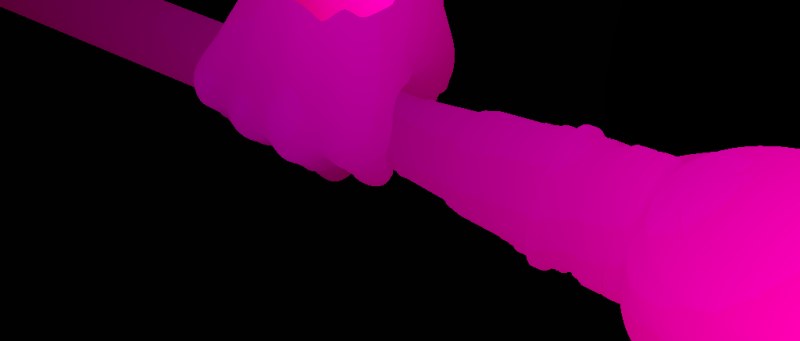
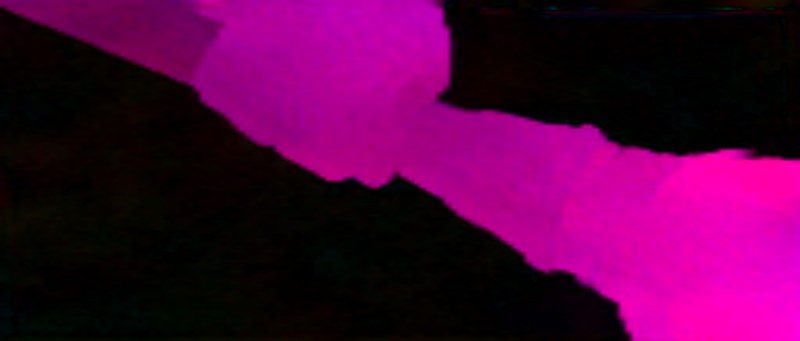 TinyFlow (Ours)Ground truth
Quantitative Results
End-point error in pixels, lower is better. Dashed reference models cannot be deployed.
Error on each benchmark
Error by motion magnitude
Visual odometry
INT8 flow into the same pose estimator, no depth. TinyFlow has the lowest ATE on 7 of 11 sequences.
Robustness to illumination change
Gamma and brightness changes on the second frame. TinyFlow stays within 5.92 to 8.99 EPE, while EdgeFlowNet rises to 27 to 61 and NanoFlowNet to 18 to 90.
Contact: xiaoao.song@colorado.edu, chahat.singh@colorado.edu